
101 Pharmacology Fill-in-the-Blank Exercises
For Nurses, Nursing Students, and Healthcare Professionals
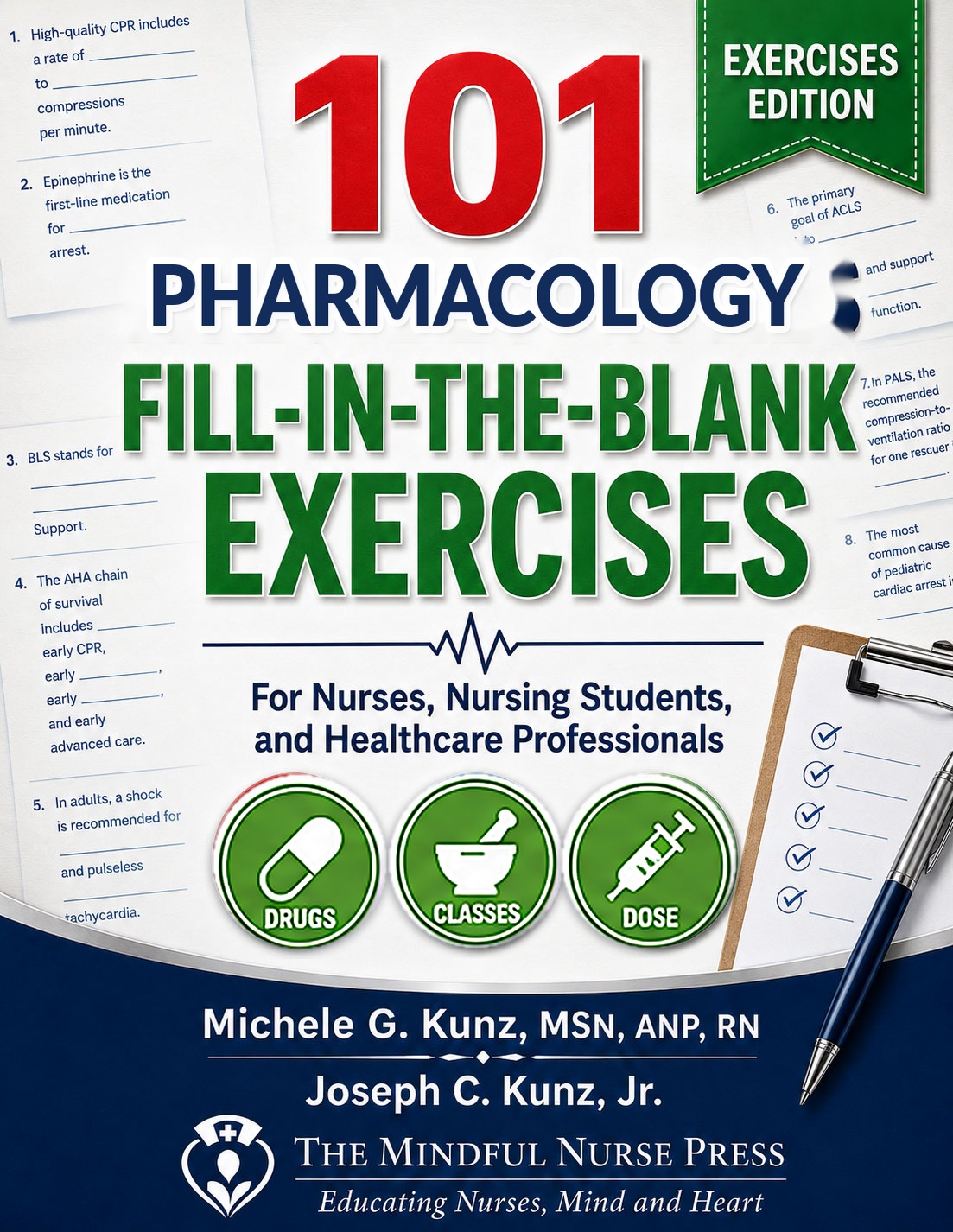
Put Your Pharmacology Knowledge to Work—One Blank at a Time
Pharmacology can create a convincing illusion of familiarity. A medication name looks familiar. A drug class makes sense when the completed statement is already on the page. Then one important term disappears—and you have to decide what belongs in the blank.
This book turns passive recognition into guided active recall across 101 pharmacology topics.
About This Book
The exercises begin with pharmacology foundations and progress through pharmacokinetics, pharmacodynamics, medication administration, safety, autonomic drugs, major therapeutic drug families, and a final comprehensive challenge. The exercise sequence matches the topic architecture used by the Pharmacology Crossword and Word-Search editions.
Each exercise presents a Word Bank and a set of incomplete pharmacology statements. The learner fills each blank with the correct term, and each term is used once. The choices narrow the problem, but understanding determines which relationship fits.
What You’ll Find Inside
- Foundations of Pharmacology: What pharmacology is; generic, brand, and chemical names; classifications; drug development; prescriptions and medication orders; drug references; abbreviations and symbols.
- Pharmacokinetics and Pharmacodynamics: Absorption, distribution, metabolism, excretion, half-life, onset, peak, duration, receptors, agonists, antagonists, therapeutic index, and dose-response relationships.
- Medication Administration and Safety: Rights of medication administration, routes, enteral/parenteral/topical/transdermal medications, dosage calculations, medication errors, high-alert drugs, adverse effects, allergies, and interactions.
- Autonomic, Cardiovascular, and Respiratory Drugs: Cholinergic, anticholinergic, adrenergic and blocking drugs; antihypertensives, diuretics, ACE inhibitors/ARBs, calcium channel blockers, beta blockers, nitrates, antiarrhythmics, heart-failure drugs, anticoagulants, thrombolytics, lipid-lowering drugs, bronchodilators, corticosteroids, antihistamines, decongestants, and asthma/COPD drugs.
- CNS, Pain, Anesthesia, and Anti-Inflammatory Drugs: Sedatives, anxiolytics, antidepressants, antipsychotics, mood stabilizers, Parkinson and seizure drugs, stimulants, Alzheimer drugs, opioids, opioid antagonists, NSAIDs, acetaminophen, migraine drugs, anesthetics, and gout/arthritis drugs.
- Anti-Infective and Endocrine Drugs: Antimicrobial principles; major antibiotic families; antitubercular, antifungal, antiviral, and antiretroviral drugs; insulin, oral antidiabetics, thyroid drugs, corticosteroids, pituitary/hypothalamic drugs, reproductive hormones, and bone/calcium drugs.
- GI, Renal, Immune, Blood, Oncology, and Special-Use Drugs: Acid-reducing drugs, antiemetics, bowel medications, IBD drugs, digestive enzymes, fluids and electrolytes, bladder and acid-base drugs, vaccines, immunosuppressants, anemia drugs, chemotherapy, biologics, antirheumatic drugs, vitamins, supplements, dermatologic, ophthalmic, otic, herbal, and complementary products.
- Comprehensive Challenge: Exercise 101 draws material from across the entire book into one final pharmacology review.
- Word-bank guided recall: The exercises require you to distinguish among medications, classes, mechanisms, effects, routes, safety concepts, and related terminology.
- Exercise 101 — The Ultimate Pharmacology Challenge: The final exercise pulls concepts from across the book into one comprehensive review.
- Complete answer key: Check each response and use uncertain blanks to identify the exact drug family or principle that needs more review.
Who This Book Is For
- Nursing students who want to supplement pharmacology coursework with active written review.
- Pharmacology students who want practice connecting medications, classes, mechanisms, effects, routes, monitoring, and safety concepts.
- Nurses and healthcare professionals who want a focused way to refresh familiar medication information.
- Healthcare students whose education requires a working knowledge of pharmacology.
- Healthcare educators looking for topic-specific supplemental exercises.
- Learners who want to discover what they can recall when part of the information is removed.
How This Book Works
Each exercise gives you a focused word bank and incomplete statements. You read the statement, identify what kind of pharmacology relationship it is asking about, compare the available terms, and choose the one that correctly completes the idea.
That makes the format guided active recall. The word bank gives enough structure to concentrate on distinguishing among related concepts, but it does not provide the relationship itself. You may recognize every term on the page and still discover that you cannot confidently decide where each one belongs. That is useful information.
Why the Word Bank Matters
Completely unaided recall is valuable, but it is not the only useful retrieval task. A focused word bank helps learners compare related medications and concepts directly. A difficult blank may reveal that two drug classes are being confused, a mechanism is unclear, an antidote is forgotten, or a medication name is familiar without its monitoring implications being firmly connected.
That turns a mistake into a study direction. The three Pharmacology books then allow the same broad subject to be revisited as recognition, clue-based retrieval, or recall in context.
About the Authors
Michele G. Kunz, MSN, ANP, RN
Michele G. Kunz is a nurse practitioner, longtime nursing educator, author, and healthcare instructor whose work focuses on making complex clinical material easier to organize, review, and remember. Through The Mindful Nurse Press, she develops practical educational resources for nurses, nursing students, and other healthcare professionals.
Joseph C. Kunz, Jr.
Joseph C. Kunz, Jr. is an author and publisher who has been developing educational materials and study guides for students and professionals since 1985. He works with Michele to organize complex healthcare subjects into clear, practical learning resources presented through multiple study formats.
Educational Note
101 Pharmacology Fill-in-the-Blank Exercises is intended for educational, recreational, and general review purposes. It is not a clinical drug reference, prescribing guide, or source of medical advice and does not replace formal instruction, clinical training, current medication references, manufacturer prescribing information, institutional policies, professional judgment, or applicable clinical guidelines.
Medication information changes. New drugs, indications, warnings, contraindications, interactions, formulations, and recommendations may appear after publication. Healthcare professionals and students should consult current authoritative sources when making medication-related clinical or educational decisions.
Book Details
- Title: 101 Pharmacology Fill-in-the-Blank Exercises
- Authors: Michele G. Kunz, MSN, ANP, RN & Joseph C. Kunz, Jr.
- Publisher: Dickson Keanaghan, LLC
- Imprint: The Mindful Nurse Press
- Publication Date: September 2026
- Edition: First Paperback Edition
- Format: Paperback
- Page Count: 121 pages
- Trim Size: 8.5 × 11 inches
- ISBN: 978-1-933230-97-9
- Language: English
The Complete Pharmacology Puzzle Series
Study the same subject three different ways—through clue-based retrieval, terminology recognition, and guided recall in context.
101 Pharmacology Crossword Puzzles
101 Pharmacology Word-Search Puzzles
101 Pharmacology Fill-in-the-Blank Exercises
Three formats. Three different mental tasks. One matched Pharmacology study series.